

AI's Phantom ARR
Why the recurring revenue in your AI business does not recur, and the one number that tells you before the cap table does

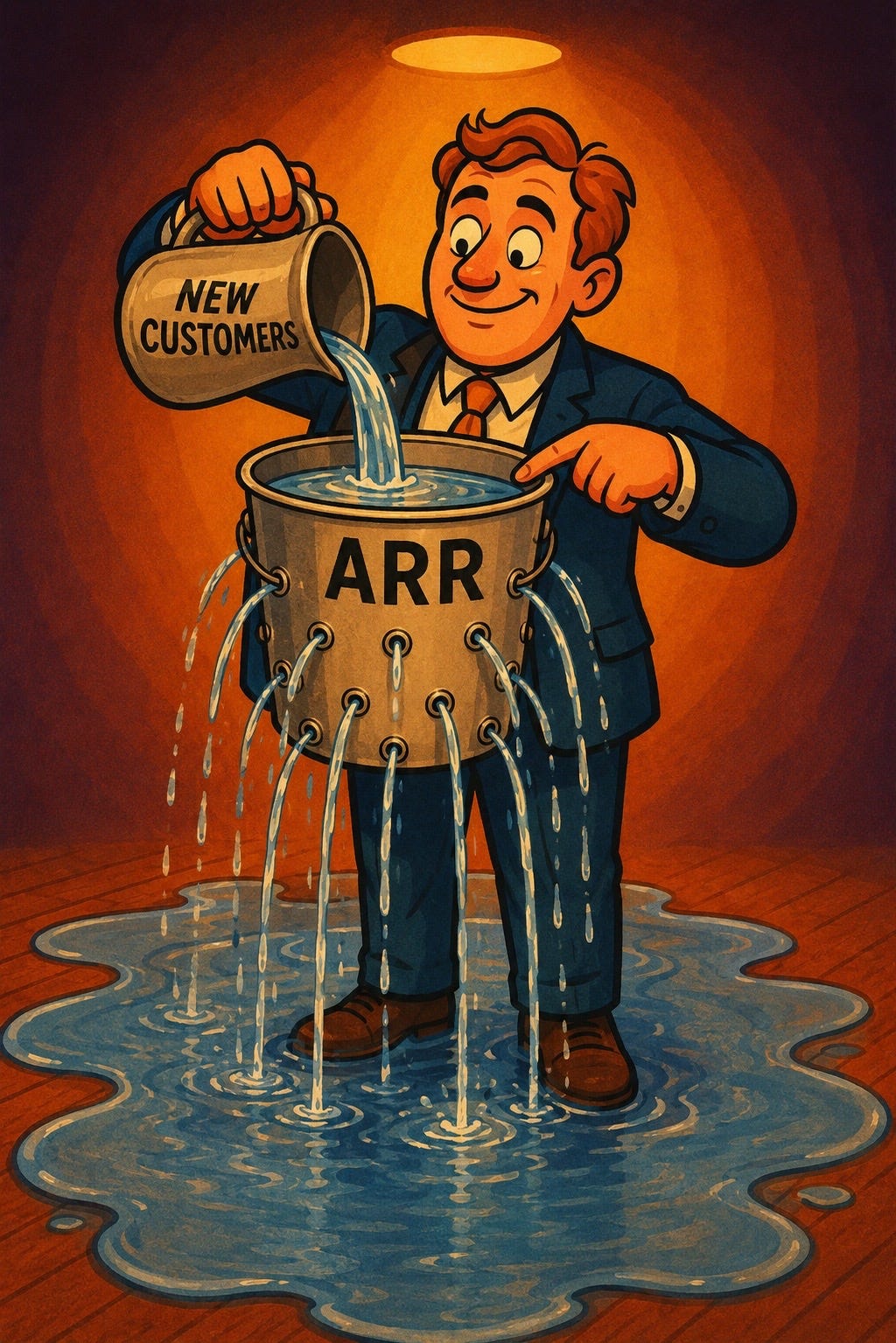
Everyone agrees that annual recurring revenue is the number you can trust, on the straightforward grounds that it says so on the tin. Recurring means it comes back, which is why software has been valued on a multiple of it for fifteen years while everyone slept soundly. The inconvenient development is that a large and growing share of the ARR now being presented across AI term sheets does not come back at all, and the founders presenting it tend to understand this rather better than the angels nodding along.
The overhyped-AI argument is a separate and more tedious one, so set it aside. What matters here is a measurement that has quietly stopped measuring the thing it claims to. ARR was always a polite fiction, an annualized snapshot dressed as a promise, and it held up for years because software was sticky, switching was a nuisance, and the revenue genuinely tended to renew. AI has broken the part that made the fiction useful. The label still reads recurring while the behavior underneath reads like a free trial that happened to capture a card number.
Recurring that has no intention of recurring
Call it Phantom ARR, revenue booked as recurring that has no intention of recurring. It arrives in the data room as a clean, growing line, and it reappears twelve months later as a customer who tried the product, got bored or got a better model, and left without ceremony or notice.
Here is the figure that should end the polite nodding. Median gross revenue retention for AI-native companies sat at around 40% in late 2025, against roughly 63% for B2B SaaS measured the same way, according to ChartMogul’s retention analysis with Kyle Poyar. Read that slowly. The median AI-native company keeps 40 cents of every revenue dollar a year later and loses the other sixty, where a traditional software business in the same dataset holds close to two thirds, and the market is currently valuing them on the same multiple regardless.
The consumer end tells the identical story in a different accent. RevenueCat’s 2026 report, drawn from more than a billion transactions, found AI apps retaining 21.1% of annual subscribers after twelve months against 30.7% for everything without AI in it. The AI products convert better and monetize harder on the way in, which is precisely what makes the back end so easy to miss. The money arrives fast, the headline looks magnificent, and the churn only surfaces once a cohort has had a full year to wander off. Budget-tier AI products fared worse again, holding barely 23% of their starting revenue across a year, which is a tidy way of saying they lost more than three quarters of it.
The disguise
Growth is what disguises all of this. A company shedding 60% of its revenue can still post a magnificent top-line number if it acquires fast enough, because the new dollars arriving at the front more than cover the old dollars leaving at the back, right up until the moment they no longer do. That is the quiet menace of a leaking base inside a hot market. The acquisition machine runs so hard that nobody in the room thinks to ask how many of last year’s customers are still around, and the answer, increasingly, is fewer than half of them.
None of this is mysterious once you stop treating AI revenue as software revenue out of habit. It is priced on growth and built on experimentation. A finance team adopts a writing tool to see what the fuss is about, signs a contract with a quarterly opt-out, and watches a model two notches better launch before the renewal date even arrives. The revenue was never embedded in a workflow, it was sampling a capability, and capabilities in this market get replaced monthly. Poyar is blunt about the mechanics, pointing to how much AI revenue is experimental product that never reaches production, and to contracts where the large majority of users simply opt out, which is a reasonable description of non-recurring revenue wearing a recurring revenue coat rather than anything that looks like a software business having a rough patch.
Consequences
The valuation consequence is where this stops being an accounting curiosity and starts costing real money. A software multiple is a bet on durability, the assumption that a dollar of revenue today is most of a dollar next year and most again the year after, compounding gently in your favor. Apply that same multiple to revenue retaining at 40% and the entry price is not merely optimistic, it is wrong, because the thing being paid for evaporates faster than the model quietly assumes. The founder did nothing dishonest in most of these cases. The convention itself did the lying, by handing a trial business the same metric, and therefore the same valuation grammar, as a durable one.
The tells are clear if you know to look. A deck heavy on the ARR growth curve and conspicuously light on a retention slide is saying something by omission, and a run-rate annualized from a single strong recent month is saying it a good deal louder. When a founder quotes net retention eagerly while gross retention stays in a drawer, or shows a wall of logos with no cohort sitting behind them, the information you need has not really been hidden so much as left carefully unmentioned, and the care is what is worth noticing.
The new question to ask
So the working question for anyone writing a check has to change. The headline ARR figure tells you only what a company booked, which is close to useless standing on its own, and what you actually need before trusting it is the retention sitting underneath. Start with gross revenue retention rather than net, because net can hide a leaking base behind a handful of expanding accounts and flatter a business that is quietly draining. From there, look at it by cohort, the dollars that existed twelve months ago set against how many of them survived, not a blended number propped up by new logos, and then establish what share of revenue rests on short opt-out contracts versus accounts that are genuinely in production rather than still evaluating. A founder who answers those cleanly is selling you a software business, while a founder who reaches for booked ARR and changes the subject is selling you Phantom ARR, and the gap between the two is worth more than any growth rate on the page.
This is the same blind spot seen from the other side of the table that has been quietly thinning angel returns for a while now. In that telling the cost appeared later, inside portfolios, after the checks had already cleared. Here it shows up one stage earlier, at the moment of underwriting, which happens to be the cheaper and far more forgiving place to catch it.
My verdict
Twenty years of writing pre-seed checks has taught me that the market always finds a fresh way to dress a one-time sale as a durable one, and the discipline never changes much in response, which is to ask what renews before paying for what was merely booked. AI has simply widened the gap and improved the tailoring, so the same old question now does considerably more work than it used to.
So my verdict is short, ARR is not ARR when it does not renew, and at 40% gross retention against software’s 63%, a great deal of AI ARR plainly does not.
Price the renewal, not the booking, because the rest is phantom.
If you found this article, please consider subscribing. It’s free.
Most founders spend 6-9 months fundraising. Half that time is wasted pitching investors who were never going to say yes, or taking money from angels who kill their Series A fundability.
I write about why that happens and how you can stop it. Subscribe free below to Angels & Unicorns for the pattern recognition. Upgrade if you are in the middle of a raise and looking for specific tools or you’re new to angel investing and get a direct line to me and my team.
ROI for founders: Get funded faster by the right investors. Avoid the structural mistakes that kill your Series A.
ROI for angels: One avoided bad check pays for decades of membership. Better pattern recognition is the only edge that compounds.
"[B]because software was sticky [and] switching was a nuisance"
AI promises the opposite. My team was using Cursor. Then we read that Claude was better. Two of the guys tested Claude and, within the month, everyone had dumped Cursor and began using Claude without missing a beat.
I recall an old thought experiment. Two groups of people - Average folks and traders. Two sets of identical mugs except one was red and one was blue. Everyone was given a random mug to keep. After all the mugs were distributed, everyone was given the option to exchange their mugs for the other color. Half the traders swapped mugs. The average folk did not, feeling an attachment to the mugs they were holding.
AI is turning us all into traders. If the AI becomes so good that the prime differentiator is price then uh oh.